DevLog: Week 8 System Design
As game projects grow in complexity, the "script-per-object" approach quickly reaches its limit. Week 8 of the Skills Bootcamp was a deep dive into System Design, focusing on the professional discipline of breaking down large-scale coding challenges into smaller, manageable, and interconnected modules.
My primary focus this week was on two of the most critical pillars of gameplay: Health Systems and Inventory Systems. To build these for a professional portfolio, I moved away from "quick fixes" and toward architectural patterns that a studio team could easily extend.
The Philosophy of Deconstruction
System design is about "thinking in pieces." Instead of writing one massive script that handles everything a player does, I practiced breaking problems into their constituent parts:
Data: What is the item? How much health is left?
Logic: What happens when an item is added? What happens at zero health?
Visuals: How does the UI display this information?
By decoupling these elements, I ensured that a change to the UI wouldn't break the underlying game logic, a standard requirement in professional software development.
Engineering a Robust Health System
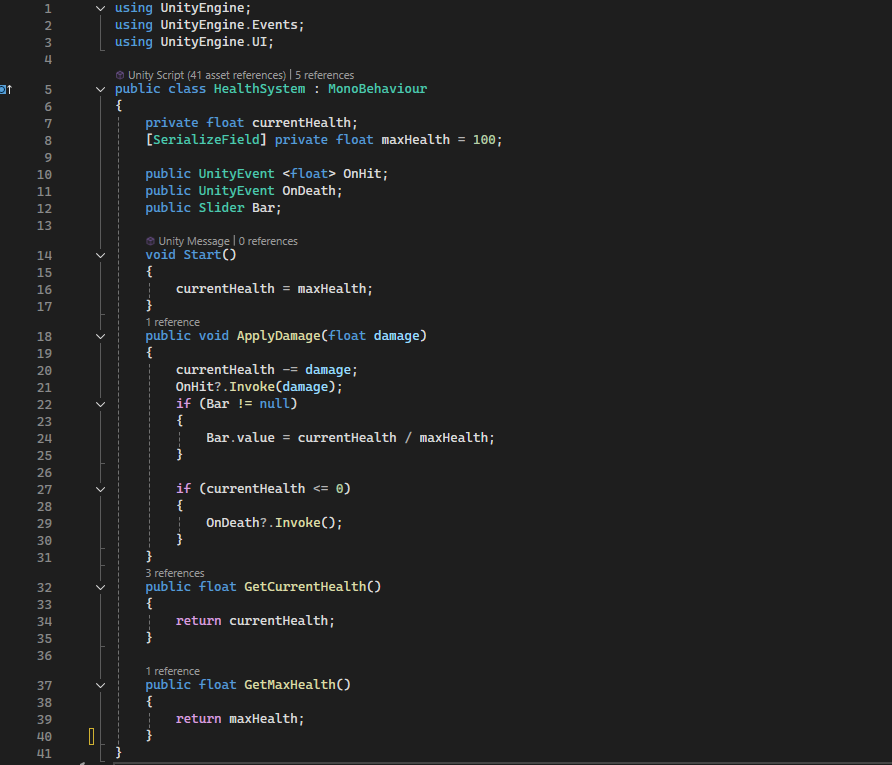
A health system seems simple on the surface, but a professional-grade version needs to be highly flexible. I engineered a Modular Health Component that can be dropped onto anything—players, enemies, or even destructible crates.
Interface-Driven Damage: I utilized an
IDamageableinterface. This allows any weapon or hazard to send aTakeDamagecall to an object without needing to know exactly what that object is.Event-Driven Feedback: Using the Unity Events I mastered in Week 2, the health system "broadcasts" when health changes. This allows the UI to update and the sound effects to play simultaneously without the scripts being "hard-wired" together.
Scalability: I implemented features for health regeneration, damage types, and "invulnerability frames," ensuring the system could handle a variety of gameplay scenarios.
Architecting an Extensible Inventory System
The Inventory system was the week's most significant technical challenge. It required a move toward Data-Driven Design.
ScriptableObjects for Item Data: I utilized
ScriptableObjectsto define items. This means instead of every "Potion" having its own heavy script, they all share a single data template. This significantly reduces memory overhead and allows designers to create new items in the Inspector without writing new code.Logic Separation: I separated the Inventory Container (the list of items) from the Inventory UI (the grid on the screen). This ensures that the game can "remember" what the player has even if the menu is closed or destroyed.
Collection Management: I practiced using C#
ListsandDictionariesto efficiently track, add, and remove items, focusing on preventing "Null Reference" errors through robust validation checks.
Professional Value: This "Systems Thinking" approach is what senior developers look for. It demonstrates that I can write code that survives the "Production Scale"—where one item might eventually become one thousand items.
Reflection: From Gameplay to Systems Engineering
I successfully implemented a "Death Loop" where hitting zero health triggers a reset player's position to a Transform location, and refills the health bar, all using clean, decoupled C# events.